Our country prides on its progressiveness, yet again America is far behind many European countries that have better educational systems, health care programs, and greater support systems for predominately female occupations. Reading Ann Critenden, Megan Pinand, Pat Mainardi, and Barbara Enhrenreich's articles, we confront the ideas that we have heard over and over again. While Ehrenreich's article "Maid to Order" express society's under recognition of household duties, like cooking and cleaning (also including motherhood), Critenden, Pinand, and Mainardi all provide reasons why domestic duties holds little value in our society. Even though domestic duties is one of the most vital societal functions, society--both men and women--have deemed it invaluable. Mainardi's "The Politics of Housework" illustrates all the reasons/excuses men have used to justify household chores as strictly a woman's obligation and responsibility--in this sense household duties is bunked down a level of importance and prestige. Critenden and Pinand both state the disadvantages women receive when becoming a mother; the continuous struggle between family and career provides little to no incentive for women to value motherhood or household chores, well at least not in a capitalistic society that thrives through competition. America, our society, have yet to give women and men any incentive or reason to value domestic work.
The idea that because of the feminist movement women's equality have been achieved and society can move on now is a phrase we hear very often, but we know that this statement is not to the slightest degree true. While the women's movement run on the platform of equality for all women, it has come to my notice that some women do not benefit from the women's movement and are unfortunately left out of this liberation of women. Throughout our readings we have seen how black women, poor women, and lesbian/bisexual women's rights were ignored, and now from this week's readings, we see how mothers and household workers are left out from benefiting--yet again some women are left behind. The opening scenario of Ehrenreich's article depict the household women are on her knees cleaning the floor. Such image, to me, represent the relationship and hierarchy within a the job world--usually men are in the highly respected jobs and women are baring the unwanted, less paid, and less respected jobs. What is extremely interesting about this article is how the household duties have been continuously debunked in its value as it goes through three stages: gender, class, race. First, women are the ones responsible for household duties. Then, the upper and middle class women are sparred from doing these chores as maid services, cleaners, and etc arise. Lastly, women of color then ends up barring the burnt of the stick, as they pick up the work upper and middle white class women does not want to do. How can the women's movement continue to leave different subgroups of women out from benefiting? Easy, its called agenda and privileged.
To talk further about the notion of privilege in relation to jobs, I want to mention some of the jobs society don't values as much. We already know the mother and household jobs, but what about janitors, people who prepare our foods (especially fast food restaurants), waiter/waitress, general workers in college facilities, etc. To bring this point closer to home, lets think about the relationship Colgate students have with the workers (such as people who work at our dinning halls, dormitory custodians, gym equipment mentor etc.) While there are indeed people who have a respect Colgate workers, I bet we can all think of people who don't. These are the people who have the mentality that they can justify their actions because "that's the _____ (worker's job) and that's what he/she is suppose to do." It is privilege to hold oneself higher than another person. It is also privilege to judge which jobs are worth values and which jobs are not. Likewise, the motherhood image and household chores are also functioned under privilege for those who place the values onto these unrecognized jobs and society's privileged to justify who does these jobs.
Tuesday, March 29, 2011

Monday, March 28, 2011
Main Post 3/28
In Crittenden's "The Mommy Tax", they talk about the underlying issue of being a mother and the income that you receive. In the beginning of the article, it talks about a ceremony celebrating the equality of men and women in the workplace because women's income had reached 98 cents to a man's dollar. However, this difference only included women from the ages of 27-33 who were childless. After pointing this out, Crittenden then goes on to explain her own experience of having to stop writing for the New York Times in order to carry out her duties as a mother. Her annual income went from 50,000 to 15,000, forcing her to lose between 600,000 and 700,000 dollars no including the loss of her pension. She also talked about how the French have the lowest mommy tax, and how the Bible even makes a reference to women being inferior to men when God instructs Moses to tell the Israelities that women, for purpose of tithing, are worth 30 shekels, while men are worth fifty.
After reading Ehrenreich's "Maid to Order" It was striking to find how household work in the fifties compares to household work now. Household work in the fifties was acceptable and was the equivalent or equalizer of the male work place. All women were workers with the rare exception of wealthy women who hired other women to do their work. However, now there is the connotation that house maids are associated with lower levels of education and a degrading connotation now that more people have more prestigious jobs in offices.
In "Stories from the Sidelines", Pinand talks about the balance between work and family. After taking a women's studies course in college, she applies to the Women's Leadership Scholars Program and was accepted. She observed two of her bosses and got different opinions and views on how to balance family and work. She referred to her 2nd boss as a "super mom" because she was passionate about both her work and family and was in tune with both worlds. She concludes that its not just up to the individual person and the context of their lives on whether or not they can balance both worlds, but rather it revolves around "workplace policies, federal policies, family structure, stereotypes about gender roles, and the attitudes of coworkers and management".
In Mainardi's "The Politics of Housework", he translates different scenarios as excuses of why men wouldn't want to do housework. The translation that stood out to me the most and that I can relate to the most is the one where the translation talks about how men are not good at washing dishes or cooking or laundry and they are better at the carpentry jobs. I find that whenever my Mom asks for my Dad to keep the house clean while she is away, he isn't really sure how she does the laundry day in and day out, and he likes to yard work chores rather then laundry or cleaning. However, I do have to give him credit that he is always the one who does the dishes! I thought that this reading was interesting because there was a contrast of what I could picture as reality, but another side where I could never imagine a man saying this to his wife. I think that all 4 of these articles touched upon the workplace for women and this article added a twist on it since it was written by a man.
Love It or Hate It
The article that I found the most interesting and eye opening was Barbara Ehrenreich's article "Maid to Order". I found her reflections on maids and the outlook on housework extremely fascinating. Ehrenreich's discussion of the two varying views women had of housework made the biggest impact on me.
Ehrenreich writes how others believed that housework was supposed to be the "great equalizer of women", and how it was a "economically productive and significant workplace, an extension of the actual factory, since housework served to 'reproduce the labor power' of others, particularly men". This notion that housework was a beneficial, equalizing "job" was based out of the notion that women were leveling themselves with the men. It also reminded me of the typical 50's housewife image. The women who dresses up in high heels and pretty dresses to do housework and loves every minute of it. This
image could not explain it better.
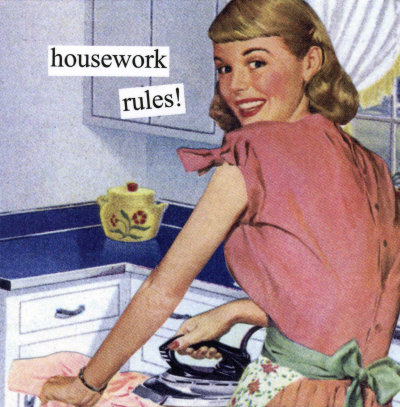
Women were constantly portrayed as loving housework. Women took pride in keeping a clean home and caring for their husbands.
This happy 50's housewife contrasts with the opposite view on housework. Ehrenreich discussed a more "feminist" approach to housework and the affects it had for women's power. Instead of housework loving women, Ehrenreich reports on other women's views of housework some that included- "housework defined a relationship between human beings" and the theory that if it is constantly a woman cleaning up after a man "you have a formula for reproducing male domination from one generation to the next. Hence the feminist perception of housework as one more way by which men exploit women". Or a more crude image depicting the same view-

It seemed that the feminists directly contradicted the previous "housework loving" women. What interested me about this difference of opinions was that it had changed over time and so I became interested in what the society I lived in thought about housework. I grew up with my mother staying at home to raise me and my sisters while my dad worked during the day. However, once I got older and my mother started participating in more charity work, she hired someone to help out cleaning around the house. I never thought that a "maid's" work was less sophisticated or demeaning than for example my mom's job helping out at a school. But sadly, I did feel that maybe she had become a maid because she wasn't offered a better education or because of the language barrier she couldn't find a higher paying job. As embarrassed as I am to say that, I think that it tells a lot about our society today. Instead of looking at housework as a wonderful exciting thing, or a way for men to "exploit" women; I think that because there are so many women working in high ranking jobs, and many famous women with successful careers, it gives off the image that women can succeed just as far as men. So over time I gradually developed the idea that any woman could be just as successful as a man. Because I developed this idea, I think I was more inclined to believe that it wasn't that maids could not reach the higher paying careers, but instead that they were not given equal opportunity to.
Overall, Ehrenreich's article made me notice what my own society thought about housework and the affect it has on me and my own view of housework.
Subscribe to:
Posts (Atom)